

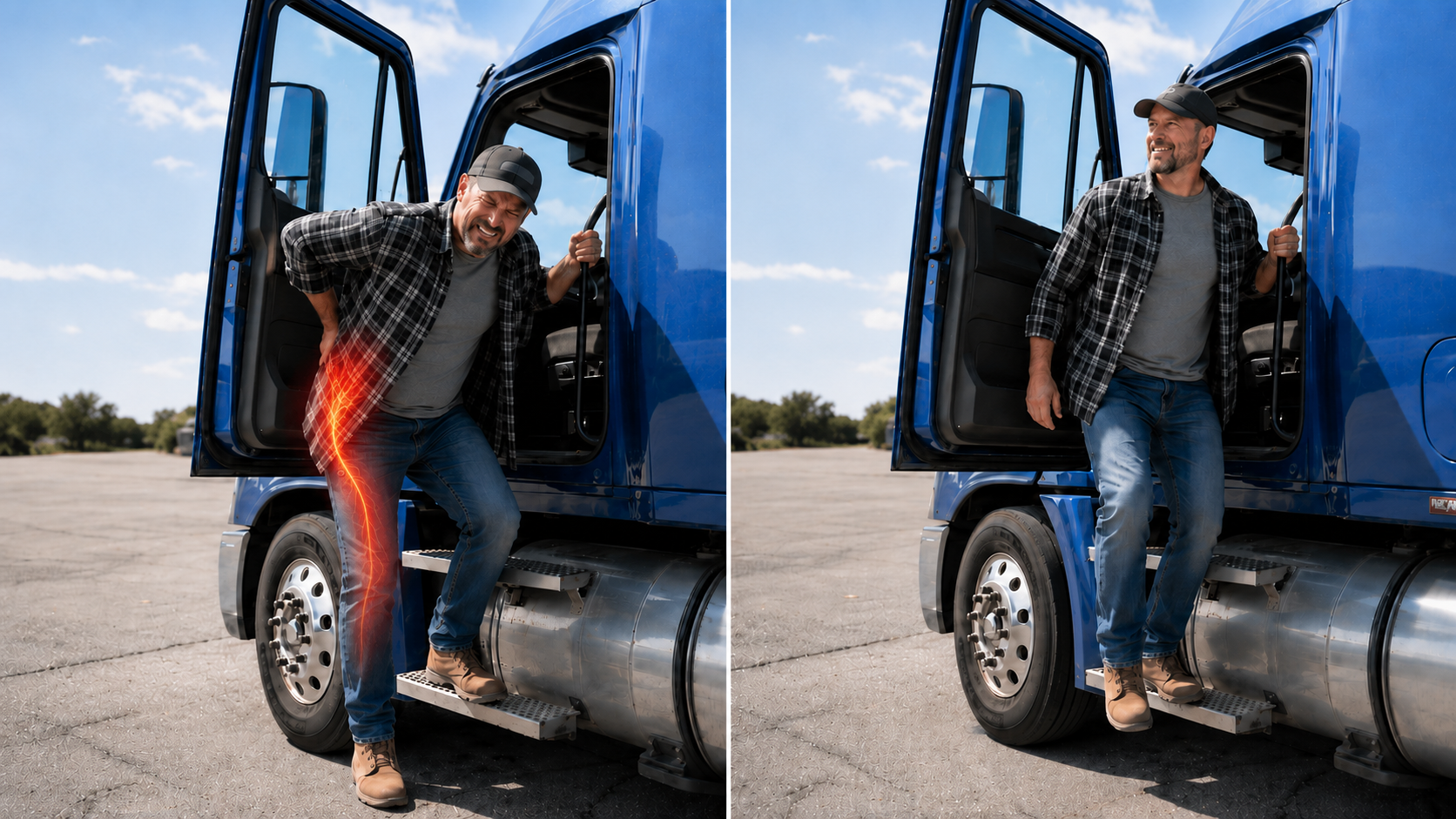
Use This 3 Min/Day Plan ToDrive Without Back Pain
 50% less pain and stiffness in 6 weeks
✓For Truckers who sit all day and night
✓No equipment, pills, injections, or surgery
50% less pain and stiffness in 6 weeks
✓For Truckers who sit all day and night
✓No equipment, pills, injections, or surgery
Look Familiar?
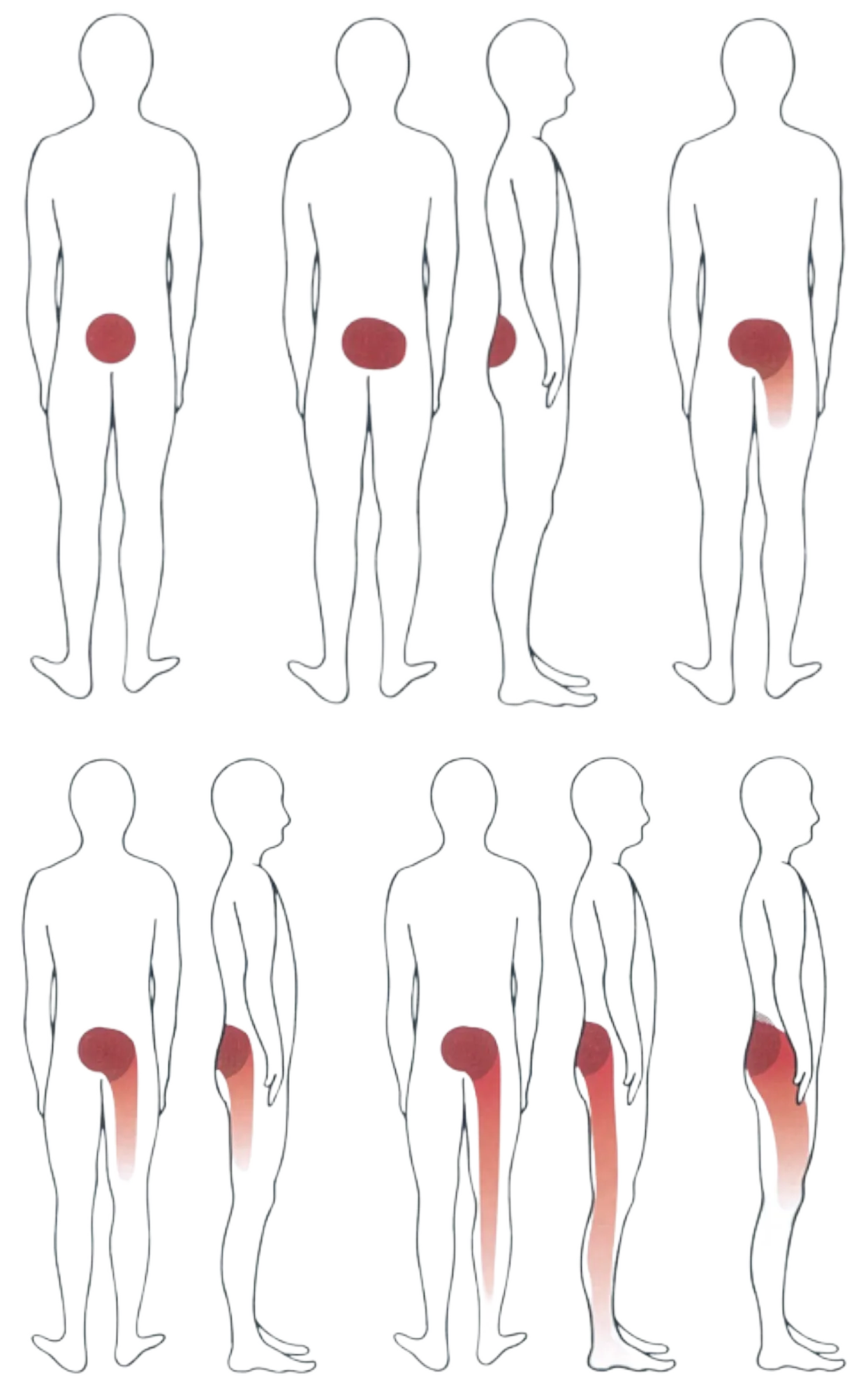
How the pain spreads further from the spine the longer it goes unaddressed.
Lifetime Access
Will This Work for Me?
The more questions you can say yes to, the more closely your pain pattern matches the kind that responds well to this self-treatment program.
It's called Seated Nerve Compression — and it's literally a pain in your ass!
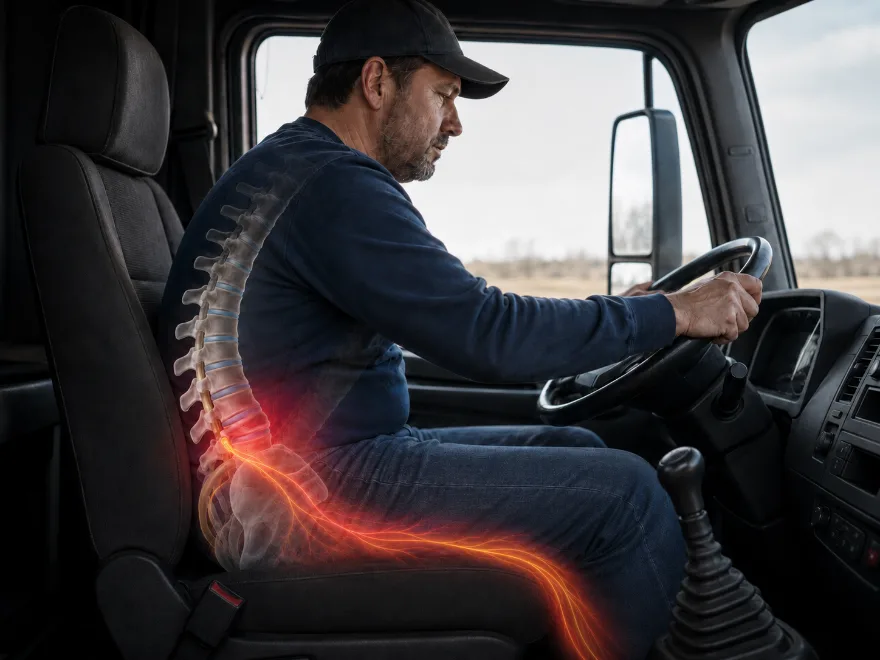
Seated Nerve Compression is what happens to a body that spends thousands of hours folded into a cab seat and never gets the one thing it needs to recover: balance and decompression.
This isn't random back pain. It follows a pattern you only see in long-haul drivers, and that pattern responds to a specific approach most doctors never look at.
You don’t have to stop driving to start getting relief.
Instead of avoiding sitting, you can undo the negative effects of sitting with specific nerve decompression “resets” that can be done anywhere.
Two minutes a day. That is the whole commitment. Each reset takes about 30 seconds, you run it a few times between stops, and most drivers feel a real difference within days.
Dr. Raj
Take a Free Look Inside
 Drive Pain Free · Member Area
👈 Tap a lesson
Drive Pain Free · Member Area
👈 Tap a lesson
Start Here
Welcome — I'm Dr. Raj, a doctor of physical therapy. I built Drive Pain Free because too many drivers are gritting through low-back pain that's actually fixable from the cab. This isn't stretching and it isn't generic PT — it's a 2-minute daily reset matched to your pain that you can do at any rest stop. Start with the quick self-check, read the short lessons, and keep your daily routine open on the road. Let's get you driving without the pain.
Safety & Red FlagsRead this first
Before you start — whether you're at a truck stop or home for the weekend, read these first. The exercises in this program treat mechanical pain — the kind that changes with movement and position. Some symptoms point to a different problem, one that needs a clinician, not a self-help program.
- I've lost 10+ pounds in the past 6 months without dieting.
- I have a history of cancer and this pain feels new or different.
- My pain is constant and never changes — no position gives any relief.
- Severe pain wakes me from sleep at night.
- I recently had a significant fall, car accident, or injury.
- I currently have a fever, chills, or a recent infection.
- I have numbness around my groin, genitals, or inner thighs.
- I have new loss of bladder or bowel control.
- I have weakness, numbness, or heaviness in both legs at the same time.
- My leg pain does NOT improve at all when I lie down.
- Moving my neck triggers dizziness, double vision, or difficulty swallowing.
- I have a severe headache that never stops and is getting worse.
- I had a sudden “thunderclap” headache — the worst of my life.
Stop self-treatment. Reach out in the Telegram community or, for sudden severe symptoms like loss of bladder/bowel control, saddle numbness, or a thunderclap headache, go to the emergency room or call 911.
Dr. Raj Padalia, DPT — PowerBack Pain Relief
Stages of Recovery
The 3 Stages of Recovery from Pain
by Jason Silvernail DPT, DSc
Ever stubbed your toe? Bumped your funny bone? Twisted your ankle? If so, then you know all about the stages of recovery from pain. Read along, and keep your last injury in mind for comparison.
When you experience pain, your nervous system goes through three separate stages. You move through these stages every time you have pain, without exception, as long as you are alive. These stages are:
- Withdrawal
- Protection
- Resolution
Professor Patrick Wall MD described these stages years ago, and said that there was an instinctive response to help resolve pain. Let’s look at them a little closer and see how each of them are different but necessary for recovery:
Withdrawal is your nervous system’s way of removing itself from the painful stimulus, to reduce any damage it might sustain. Ever close your hand in a door or a drawer? Then you know all about withdrawal — you moved your hand back quickly without thinking about it. This is a reflex action your body has hardwired in to protect you. This is the first stage of response, and it is instinctive — it happens without your conscious awareness.
Protection is your nervous system’s way to try to ensure no further painful stress and possible damage occurs. When your hand got pinched, you grabbed and held it with your other hand, right? That’s your system’s natural protective response, and it is instinctive — it happens without your conscious awareness.
Resolution is your nervous system’s way to restore normal mobility and function to the injured part. Resolution restores the blood flow to the injured tissues so healing can take place. When you hurt your hand, and you shook it back and forth to help recover, it’s just instinctive — it happens without your conscious awareness.
When you’re stuck in the protection phase you may feel stiffness, coldness, and muscle spasm in the area. You may feel as if the body part does not want to move smoothly.
Practicing corrective movement helps you move out of Protection and toward Resolution. When you are doing the corrective movement successfully you might feel warmth, a softening, and a relaxing feeling as blood returns to the irritated tissues, mechanical stress in the tissue is reduced, and the system becomes less sensitive. This movement can be prescribed by a health care provider or it can be a natural kind of moving and stretching around to restore mobility and blood flow.
Don’t fight your body’s protective response
Many people try to fight against the protective response of the body — they try to deliberately change their posture or positioning away from the protective response so they can “look normal” again. Some common protective responses people fight against are a slight shrugging of the shoulder blade to protect the neck and shoulder area, or a shift in the low back to the left or right to protect that area.
This is usually a mistake — your attempts to force this are not likely to help. Use the movement therapy instead. Don’t directly fight your body’s natural protective responses — help your body move toward resolution and the protective response will naturally reduce. Remember what to look for with successful therapy: a reduction of the protective behavior (less stiffness, loss of motion, coldness, muscle spasm) and a freedom of movement.
Rest — Build — Strengthen
Many people seem frustrated that their pain has lasted so long, past the normal body healing time. Often, this is “mechanical pain” and is related to sensitivity of your nervous system to physical stress.
Understanding how to help your nerve tissue recover and tolerate physical stress and load again is a lot like watering your lawn. It’s not a question of just waiting for enough time for healing. It’s a question of providing the right environment and the right time for it to recover, and then the right stresses to build up its strength.
Stage 1: Rest — Let it Take Root
To get your grass to grow back, you first need to stop walking on it while it’s growing. Depending on how brown it is, you may want to walk on it just a little, or not at all. If you have a volleyball game on it, you can be sure that will REALLY slow down the process.
Your nerve tissue is the same way. As it heals, you can load it with exercise, activity, or prolonged postures more successfully. But early in this process, you need to minimize aggravating activities and prolonged positions, in order to maximize your healing. You will notice slowly that you can tolerate more activity and a longer time in different postures, but this ability is a direct result of how often you are doing the movement therapy to “dose” the tissue with blood. This stage ends when you are past the worst of the pain.
Stage 2: Build — Let it Grow
In addition to resting it, you also need to water it — that’s how it gets its nourishment. Your nerve tissue is like that too, only instead of water, it needs a regular blood supply and reduced mechanical stress in order to recover. Doing the movement therapy you’ve been practicing is how you both supply the tissue with blood and reduce the mechanical strain on the tissue. You will feel better as a direct result of the frequency that you do this in most cases.
Now, if your grass is brown and dying, you don’t want to just dump a lot of water on it the first day — that will just get you a lot of mud. You need to start slowly and work yourself up. Some increased pain is expected after you start to do the movement therapy properly. This will go away with continued movement and activity. This stage ends when most of your daily pain is gone.
Stage 3: Strengthen — Toughen it Up
After your grass has started to grow back, you need to build up the root structure so that it will be stronger. You do this by slowly walking on it at first and then spending more time on it to allow it to build up. A healthy lawn is one that is strong enough to play games on without getting torn up.
Your nerve tissue isn’t different — after it grows back in, you need to build up its tolerance by loading it with exercise and physical stress. The more you build up its tolerance, the less likely it is to get irritated again. This stage ends when you have minimal pain and you can do daily activities and additional things (like work or exercise) with relatively few symptoms.
How Long Does It Take?
It’s hard to predict the recovery of nerve irritation and nervous system sensitivity. As long as you are following the 3-step plan, you will get much better over time. It’s impossible to predict exactly WHEN or HOW MUCH you improve, but if you are doing your part, it’s simply a matter of time before things improve.
Rules for regrowing grass / rules for healing nerve tissue
- Keep off the grass to let it take root / Avoid aggravating things early
- Water it slowly to build it up / Restore its health with therapy
- Toughen it up with activity / Strengthen it with exercise
Understanding Mechanical Pain
You’re Not Alone
Often people who are in your shoes describe pain as having come out of nowhere, or that the pain has stuck around for far too long, and they usually aren’t able to associate the pain with a particular injury or trauma. Or, if there was a distinct injury, the pain stayed around much longer than the time it normally takes to heal. In an attempt to “find” the pain, you may have had x-rays, MRIs, scans, or other tests that didn’t come up with any answers. You may have had care providers who haven’t been able to explain what was wrong, or been prescribed medications that only helped a little or maybe didn’t help at all. You may have found that rest doesn’t help, that prolonged positions — sitting at a desk, driving in a car, or standing for a long time — make the pain worse. You may feel stiff and achy, particularly in the morning, and find that you have to fidget and keep moving to stay comfortable. And when you do move, you may hear crunching or popping noises that worry you. If any of these sound familiar, you may have mechanical pain.
How Does Pain Work?
The pain you are experiencing is due to nerve tissue in your body sending your brain a signal, and an increased sensitivity in your system to those signals. This “danger signal” is received and your brain makes a decision about whether it will be painful or not, based on your current level of sensitivity and the threat your brain determines. Pain doesn’t come from the body tissues; it comes from your nervous system — and it’s all about how your body interprets a complex web of signals it is receiving. Relieving your pain is mostly about reducing the signals going up to your brain and reducing the overall sensitivity of the system.
There are two ways to stimulate the nerve tissue in the body to produce danger signals: chemically and mechanically. Muscles, joints, bone, tendons, and ligaments don’t send signals to your brain the way nerves do — they have nerve tissue all around them that is responsible for this communication. Your nerves are always sending up danger signals to help keep you safe, and they usually don’t indicate any tissue damage has been done. When more danger signals arrive over a short period of time, or if your system is more sensitive than normal, you are more likely to have a pain response.
So really there’s no such thing as “bone pain” or “muscle pain” — there is only pain from stimulation of nerve tissue in that body part. When you have pain in your skin from a cut, it isn’t your skin itself that hurts, but the nerve tissue that lives in the skin that is talking to you.
Chemical irritation is part of the inflammation process — the first way to stimulate nerve tissue. If you’ve ever had sunburn, a sprained ankle, or a cut on your finger, you know what chemical pain feels like. The pain is more or less constant no matter what position you are in, and you can relieve it with ice and anti-inflammatory medications. The body clears the chemicals irritating the tissue with time as part of healing.
Mechanical strain is the second way to stimulate nerve tissue — it is pressure or tension in the nerve tissue. Mechanical pain changes with position and movement, worsens with prolonged positions, and doesn’t respond very well to anti-inflammatory medications, time, or rest.
Won’t an X-ray or MRI show this mechanical pain?
No. Mechanical pain is a problem with the way the tissue feels, not the way it looks. It is not a structural problem (like a broken bone), it is a functional problem. If someone took your picture right now, they could tell you how you look, not how you feel. In medical studies, people with no pain have been found to have advanced arthritis, torn cartilage, and even herniated disks — so in the absence of a major injury, the scans aren’t that important to diagnosing and treating your pain. What you have is chronically irritated tissue and an overall sensitive system, not broken or damaged tissue.
What Can I Do to Help It?
Anti-inflammatory medications aren’t usually very helpful — this is tension and pressure, not inflammation. The solution for mechanical pain is movement: movement that relieves the tension in the system and reduces its sensitivity. When nerve tissue is under strain, the small blood vessels that deliver blood to it are pinched, reducing blood flow on top of the tension. Resolving the pain involves reducing the strain and restoring normal blood flow. One way to think of mechanical pain is to think of someone twisting your finger — what we have to do is “untwist” it.
Is This Like a Pinched Nerve? Not Really…
Usually when people talk about pinched nerves, they mean one specific nerve that has been compressed — with numbness, burning, weakness, or a lost reflex. While this does sometimes happen, most mechanical pain is not focused on one nerve; it is more widespread. It isn’t a big major nerve getting pinched — it’s small nerves that live throughout our tissue like a spider web getting pinched and put under tension.
The Spider Web and Movement That Helps
The nerve tissue branches throughout the body like a spider web, sending and receiving signals from place to place. Picture a spider web for a moment: if you pull on one strand, the whole web moves — the tension is distributed throughout the system. That’s why it’s sometimes hard to find the movement needed to restore blood supply and ease tension, and why stretching and exercising in the past may not have helped. The movement that helps your pain is the movement that eases the strain and restores the blood supply.
What you learned in Part 1
- Pain doesn’t have much to do with your scans and tests
- Pain is about how you feel, not how the scan looks
- Small nerves are spread throughout your tissues like a spider web and report danger when irritated
- Pain is about threat, set mostly by two things: danger signals and the sensitivity of your nervous system
- There are two kinds of danger signals: chemical and mechanical irritation
- Most danger signals aren’t indicators of damage
Understanding Threat
When you have a pain response, it’s because your system has decided there is a situation that requires action on your part to avoid danger. This judgment is made deep inside your brain and is something you often don’t have much control over.
Understanding Sensitivity
As your body receives more danger signals and feels threatened, the system gets more sensitive to danger. It’s a learning process your brain and body use to better protect you — happening in the nerve tissue throughout your body, in your spinal cord, and in danger-processing areas of your brain. This is a biological response your body builds up, often without your knowledge. But anything that can be sensitized can be de-sensitized.
An Example: Threat and Sensitivity
Imagine you’re hosting a party — daytime, house full of friends, music, well-rested. A friend jumps out of a closet in a scary mask and yells “Boo!” Are you scared? Probably not. Now imagine you’re home alone at night, lights off, watching a scary movie after a news story about a home intruder, exhausted and stressed. The same friend, same mask, same yell — now you’re terrified. The danger signal never changed. The context, threat, and sensitivity did. Pain works the same way: the more threat something carries and the more sensitive your system, the greater the pain response.
How Do I Reduce Threat?
- Understand your problem in detail. Reducing uncertainty calms your body’s biological response.
- Make a plan with your provider — treatment options, approaches, and what’s likely ahead.
- Gain experience with less pain and better function through active, movement-based rehab. Passive treatments done to you are less likely to help.
How Do I Reduce My Nerve Sensitivity?
- Get enough sleep — most adults need 7–8 hours a night
- Improve your sleep quality
- Get regular aerobic exercise — work toward 150 minutes of moderate-to-vigorous activity a week, starting slow
- Strength train 2–3 times a week (weights, machines, bands, or bodyweight)
- If you are depressed, get treatment — it works and helps your pain too
- Manage stress and learn to relax — a hobby, exercise, talk therapy, deep breathing, or meditation
Building a Plan — The Therapy Buffet
Think of therapy like a buffet with two kinds of food. Main dishes are what everyone should have and are all most people need. Side dishes are optional — fine if you want them, but not critical.
Main dishes
Education about the problem, active exercise therapy, staying physically active, and reducing threat and sensitivity with good sleep, regular exercise, treatment for depression if you have it, and stress management.
Side dishes
Manual therapy like spinal manipulation and massage, pain medications, needling treatments like dry needling or acupuncture, hot and cold packs, lasers and ultrasound, kinesiology taping, electric stimulation, and injections.
Once you have your treatment plan and you are reducing threat and sensitivity, you are well on your way to feeling better.
Credit: Jason Silvernail DPT, DSc
Understanding Seated Nerve Compression
Ten-plus hours folded into a seat keeps your lower spine bent forward and loaded. Here’s what that pattern is, how the resets reverse it, and how to know they’re working.
Seated Nerve Compression
Your Body Craves Balance
You cannot avoid sitting. If you drive for a living, the seat is part of the job.
So the answer is not to stop driving. The answer is to undo what sitting does to your spine throughout the day.
Your body craves balance. When your spine spends hours bent in one direction, it eventually needs the opposite direction to even things out. The problem is that driving keeps your lower back in the same position for hours at a time.
Sitting folds the spine forward. Reaching for the wheel, leaning over paperwork, climbing in and out of the cab, and sitting through long runs all keep feeding that same forward-bent position. For most drivers, the lower back spends all day going forward and almost no time going backward.
The spine was built to bend both ways. Think about how often your spine goes forward every day — sitting, lifting, loading, driving. Now think about the last time it bent the other way. That movement is what your spine has been starved of. Starved movements create unhappy nerves.
That missing movement matters.
When your spine spends ten or twelve hours folded forward, the joints, discs, muscles, and nerves all get loaded in the same direction. Then road vibration adds even more stress. Every bump, pothole, and engine cycle sends force through a spine that is already compressed.
That is why trucker back pain is different. This is not the same as sitting at a desk. You are sitting for long hours while your spine is being loaded, shaken, and held in the same position run after run.
In this program, we call this pattern Seated Nerve Compression. It is what happens when your lower back spends thousands of hours folded into a cab seat without enough movement in the opposite direction. The spine stays loaded, the discs stay compressed, and the nerves can get irritated.
This isn't random back pain. It follows a pattern you only see in long-haul drivers, and that pattern responds to a specific approach most doctors never look at.
Why Pain Travels Away From Your Spine
A nerve does not like being compressed.
The more pressure on the nerve, the more irritated it becomes. The more irritated it becomes, the louder it complains. And when a nerve gets angry enough, you may not just feel pain in your lower back anymore.
You may feel it farther away from the spine.
That is why back problems can show up as pain in the hip, butt, thigh, calf, or even the foot. The problem may start near the spine, but the pain can travel along the nerve.
That is also why the location of your pain matters.
Pain that stays close to the lower back usually means the nerve is less irritated. Pain that travels farther down the leg usually means the nerve is more irritated and needs more pressure taken off it.
So if sitting compresses the nerve, the solution has to do the opposite.
You have to take pressure off the nerve.
Not just stretch whatever feels tight. Not just rub the sore spot. Not just cover up the pain for a few hours.
The more the nerve is compressed from sitting, the more important decompression becomes.
Compressed nerves send pain. Decompressed nerves go quiet. When the nerve has room to breathe, it stops firing. The pain doesn't disappear because you masked it — it disappears because you removed what was causing it.
That is why the goal is not random stretching. The goal is balance.
If driving folds your spine forward all day, your reset has to open it back up throughout the day.
That is what the 30-second decompression resets are built to do. They are short, targeted movements that help reverse what ten-plus hours in the cab does to your spine and take pressure off irritated nerves.
When the spine moves in the opposite direction from what causes pain — the pain goes away.
The rule is simple
Since you cannot avoid sitting, you have to undo sitting.
That is the foundation of Drive Pain Free.
About Your Pain
Seated Nerve Compression
Thousands of hours in a cab seat — combined with road vibration, loading, and the constant forward hunch of driving — creates a specific compression pattern in your spine. We call it seated nerve compression. The discs in your lower back get squeezed forward, hour after hour, mile after mile. This protocol is designed to reverse that pattern.
Where Does Back Pain Go?
In a first attack, pain is usually felt in the center of the back, at or near the belt line, or just to one side — and it typically subsides within a few days.
In subsequent attacks, pain may extend to the buttock, and later to the back or outside of the thigh, down to the knee, or below the knee to the ankle or foot. Less often, pain is felt in the front of the thigh.
Pain may vary with movement or position — one movement may cause buttock pain, another may cause that pain to leave the buttock and reappear in the low back. This shifting behavior is actually a good sign.
If you have a severe problem, in addition to low back pain you may experience significant numbness or muscular weakness in the lower leg.
Can You Treat This Yourself?
Most people will benefit from the exercises in this program, and many will completely rid themselves of pain. Only about 10–15% will fail to derive any benefit.
Lasting improvement requires commitment to both the exercises and posture correction. You can start the exercise program immediately, provided you follow the precautions below.
If It's Not Working
Carefully watch your pain pattern once you start. If your pain was steadily worsening before you started and does not begin to improve within the first two weeks — or if your symptoms consistently increase right after exercises and you remain worse for two days — stop and seek advice from a clinician.
Do Not Start the Exercises If…
- You have severe leg pain below the knee with weakness, numbness, or pins and needles in the foot or toes
- Your back problems followed a recent severe accident
- Following a recent severe episode, you have developed bladder problems
- You are feeling generally unwell alongside this attack of back pain
- You have a previous history of cancer or tumor
- You have developed a fever, high temperature, or night sweats
- You are experiencing any other new symptoms in addition to your back pain
If any of these apply, contact your doctor before proceeding.
How Exercises Work
The Aim of the Exercises
The exercises in this program are not designed to strengthen your back muscles. They are designed to produce changes in the internal disc components in and around the spinal vertebra.
As you do them, you will notice simultaneous changes in the location or intensity of your pain. These changes are what allow you to diagnose your problem and identify which movements are helping and which are harmful.
The stretches in your daily protocol are designed around these principles. Whether you're at a truck stop, a rest area, or home — the mechanics work the same way.
The Purpose
The purpose is to eliminate pain and restore normal function — regaining full mobility in the low back, or as much as possible.
- When exercising for pain relief: move to the edge of pain, then release and return.
- When exercising to regain movement: push for maximum range, even into pain or a tight stretch.
Posture correction must always follow the exercises — and good posture must continue for life, whether or not you have pain, to prevent recurrence. In the cab, that means a lumbar roll or rolled towel in the hollow of your low back.
Things to Watch For
While performing the exercises, look for one of these responses:
- The first few movements hurt, but with repetition you move farther before pain starts.
- Symptoms disappear.
- Pain intensity increases or decreases.
- Pain moves from its usual location to somewhere else — often toward the center of the back. This is called centralization and is a very good sign.
- Range of motion improves in all directions — not just the exercise direction.
In some cases pain first changes location, then reduces, then stops altogether. These changes can happen quickly — sometimes after as few as 10 to 12 repetitions.
Centralization — The Key Sign
Centralization means your pain is moving toward the center of the low back — away from the buttock, leg, or side where you usually feel it.
If your pain moves to the midline of the spine as you exercise, you are exercising correctly. This is the most important guide for confirming you're doing the right exercises for your problem.
Directional Preference
The exercise that brings about centralization is your mechanically determined directional preference — the direction your spine needs to move to recover.
For most people, that direction is extension (bending backward). A landmark study across multiple countries involving 200+ patients found that over 90% of people using their correct directional preference exercise were better or resolved after two weeks — compared to 24% who did the opposite exercise.
The key: let the centralization of pain guide you to your correct exercise. If pain spreads outward during an exercise, that exercise is wrong for you — stop it.
What to Expect — And When to Stop
When starting, an increase in pain is common and expected. New aches in different places are also normal. As you continue, pains should diminish — usually during the first session — followed by centralization.
Once pain no longer spreads outward and is felt only in the midline, intensity will decrease rapidly over 2–3 days, and should disappear in 1–4 weeks with good posture and correct exercise.
If symptoms have been present for weeks or months, the response will be slower. Expect 10–14 days before improvement begins — but improvement will come if you are doing the correct exercises and maintaining posture.
Stop exercising and seek advice if
- Pain progressively increases in intensity after 24 hours
- Pain spreads farther from the spine after 24 hours
- Symptoms are produced or increased in the leg below the knee during exercise
How to Know If You're Exercising Correctly
You're doing it right when
- Pain centralizes — moves from leg, buttock, or side toward the middle of the low back
- Pain intensity gradually decreases
- Your range of movement increases
You're doing it wrong when
- Pain moves away from the spine
- Pain intensity increases and stays worse
- Your range of movement decreases
How to Use This Program
How to tell if the exercises are working.
Green Flags — Working
You are exercising correctly when:
- Pain centralizes — moves from your leg, buttock, or side toward the center of your low back
- The first few reps hurt, but pain eases as you continue — you move farther before pain starts
- Pain intensity gradually decreases session to session
- Your range of movement increases — you push higher or move farther each day
- Pain that was in your leg is now only in your low back — even if still intense, this is progress
- Once pain centralizes to the midline, intensity typically drops rapidly over 2–3 days
- You can drive, sit, stand, and walk for longer before pain hits
- Painful flare-ups occur less frequently and with less intensity
Caution Signs
Stop and reassess if:
- Pain moves away from the spine — spreads further into the buttock or down the leg
- Pain lingers further from the spine for more than 5 minutes after finishing — try lower force
- Pain is worse the next day than before you exercised
- Pain increases with each repetition and does not ease — wrong direction or too soon
- This episode feels different from your usual back pain
When It's Not Working — What to Adjust
No lasting change? First lever: increase frequency — do the exercises at every single touchpoint in your protocol. Second lever: move up one force level. Third lever: reach out in the community to reassess direction.
Pain spreading further after exercises? Step back to a gentler version of your exercise. If still spreading, try switching tracks or reach out in the community.
Stop Immediately If
- Pain is produced or increases in your leg below the knee
- Pain spreads further down during any exercise
- Pain is much worse immediately after and stays worse
- After 24 hours pain is progressively increasing
When to Reach Out
- No improvement after 5–7 days of full protocol
- Pain too severe to perform any exercise
- Any of the Stop Immediately criteria above
Reach out in the Telegram community — Dr. Raj responds directly.
When to Wean Off the Treatment
When you are 3 days pain-free in a row, you can start to wean off the stretches. Keep performing them as maintenance to prevent future episodes.
The Quick-Start Cheat Sheet
The whole protocol on one page — screenshot it or keep it in the cab. When in doubt, this is all you need.
The Daily Rule
- 2 minutes a day. Each reset is about 30 seconds.
- Run a reset at every stop — fuel, rest area, loading dock, before you climb back in.
- Aim for 3–4 short rounds across the day. Don’t save them all for the night.
Your Go-To Reset — Standing Decompression
- Stand tall, feet hip-width, hands on your lower back.
- Gently lean back, opening the front of your hips. Stop at a mild stretch — never pain.
- Hold 2–3 seconds, return to upright. That’s one rep.
- Do 8–10 slow reps — about 30 seconds.
You’re Doing It Right When …
- Pain centralizes — moves from leg or buttock toward the middle of your low back.
- Pain eases as you do more reps.
- Your range of motion improves.
Back Off / Reassess If …
- Pain spreads further down the leg, below the knee.
- Pain is worse the next day than before.
- Pain increases with every rep and doesn’t ease.
The Driver Community
The private group where you can ask questions and get unstuck any time — without going through a flare-up alone.
Unlock the full program →The Roadside Rescue — Bonus
What to do the second your back locks up mid-haul, so a flare-up doesn’t end your run or leave you parked.
Unlock the full program →The Pain-Free Cab Setup — Bonus
How to set your seat so you stop making it worse every mile — before the damage even starts.
Unlock the full program →Real results from the same method
These are people treated one-on-one with the same resets this program teaches. Individual results vary.
Chronic back pain
Sciatica
Choose How You Want to Start
Tap a plan to see everything inside.
What drivers are saying
“Couldn't bend or sit without intense pain. Now I'm pain-free and off my medications.”
“First time in 20 years I don't think about my back pain every five minutes.”
“Within 4 weeks I was completely pain-free with all my activities.”
“Regular PT was terrible. With this method I got an 80 to 90% reduction in pain.”
Common questions
Built specifically for commercial drivers. Every reset is matched to what a body needs after ten-plus hours in a cab. Not yoga, not generic PT, not a stretch routine handed to office workers.
No. Stretching loosens a muscle for an hour, then the ache comes back — because the load that caused it never moved. The resets work on the compression pattern itself. That's why it holds when stretching never did.
Free videos hand you a pile of random stretches with no way to know which ones fit a driver's spine — or which ones quietly make it worse. This is one targeted routine, built for Seated Nerve Compression and sequenced to undo what a day in the cab actually does. And you don't have to take my word for it — a few lessons are unlocked right here on this page, free to explore before you buy.
Two minutes a day. Each reset takes about 30 seconds. You run it a few times across your day — at a rest stop, a parking lot, anywhere flat. No equipment.
No. The whole thing fits around driving. No gym, no clinic, no time off the road.
Instantly. You get a welcome email with everything in one place — login, videos, community. Your access is for life.
Start driving without it.
Plans from $17 one-time · Lifetime access
Yes, I'm Ready to Drive Without PainThe only thing you stand to lose is the pain.
Drive Pain Free is an educational program, not medical treatment, diagnosis, or advice. It is not a substitute for care from your physician. Always consult a qualified healthcare provider before beginning any new movement or exercise program, especially if you have an existing medical condition. Results not typical. Individual results vary. By purchasing you agree to the terms.